Showing posts with label eating honey. Show all posts

Can Honey Cure Seasonal Allergies?

Image Credit: Flickr
I’ve heard over and over that if you eat locally produced honey or bee pollen, you can minimize the discomfort from seasonal pollen and tree allergies.

But, is it true?

I decided it was time to put on my researcher hat and dig up some information.

What Honey Can (And Can’t) Do
After doing lots of reading, the honey cure isn’t backed by much credible evidence.

According to the American College of Allergy, Asthma and Immunology, “There is no scientific proof that eating local honey will improve seasonal allergies. One study, published in 2002 in the Annals of Allergy, Asthma & Immunology, showed no difference among allergy sufferers who ate local honey, commercially processed honey, or a honey-flavored placebo.”

However, honey is a healthy, whole foods sweetener that offers other health benefits.

Dr. Brent A. Bauer with the Mayo Clinic explains on the clinic’s website that honey does work as a cough suppressant and has anti-inflammatory characteristics, which might help an allergy sufferer temporarily.

A Word of Caution for Allergy Sufferers
Since raw honey does contain small amounts of pollen, mold spores and bacteria (which are usually filtered out by commercial processing methods), consuming natural unprocessed honey may cause an allergic response in sensitive individuals.

“The ingestion of unprocessed honey can result in an immediate allergic reaction involving the mouth, throat, or skin - such as itching, hives or swelling - or even anaphylaxis. Such reactions may be related to either pollen or bee part contaminants,” according to the American College of Allergy, Asthma and Immunology.

So, should you eat honey if you have strong seasonal allergies? It’s best to talk with your allergist or family physician.

Do you know of any natural remedies to lessen the symptoms of seasonal outdoor allergies? I have a hubby and a few friends who would love to know what works for you! Please share your ideas in the comments below.

Until Next Time,
Choose Healthy!

Whole Foods Living

Beyond Honey: Eating Bee Pollen and Bee Bread

Photo Credit: SXC
Last summer as I was browsing my local farmer's market, I spotted the honey table.

I just love our local honey producers and all the wonderful things they create from the honey-making process including beeswax lip balms and decorative candles, to whipped honey spreads and beeswax lotion bars.

Bee Pollen is Edible
Then I spotted the bottle of bee pollen. What? You can eat bee pollen?

The seller explained its great for people with outdoor allergies to eat locally produced bee pollen to help build up a resistance to local allergens. Also, bee pollen is chock full of vitamins.

So, I had to investigate. According to the Los Angeles County Beekeepers Association bee pollen is a natural:
  • anti-inflammatory food
  • boosts the immune system
  • contains complete proteins
I've been adding the small granules to my yogurt, cereal and smoothies. Bee pollen has a distinctly earthy flavor with a hint of sweetness. It doesn't remind me of honey at all.

Discovering Bee Bread
Recently I was chatting about bee pollen on Twitter, and the friendly folks at Bee Healthy Farms in Missouri asked if I wanted to try its Api-Nuggetz Organic Bee Bread product. Sure! They claim the bread is nature's superfood made from wildflower pollen collected by wild bees.

According to the company's website:

"Bee bread contains practically all the essential amino acids for humans - (phenylalanine, leucine, valine, isoleucine, arginine, histidine, lysine, methionine, proline, threonine, tryptophan), vitamins - (A, B1, B2, B3, B6, C, E, biotin, folic acid, rutin) and minerals - (calcium, iron, potassium, phosphorus, sodium). The major components of pollen are proteins, amino acid, lipids (fats, oils or their derivatives) and sugars. Enzymes (proteins) are also present but some, like glucose oxidase, have been added by the bees. This enzyme is therefore more abundant in bee bread than in fresh pollen pellets."

So, how was the bee bread? First of all, it's not bread, as in a loaf or a roll. The product resembles small pebbles, ranging in size from a small pea to a raisin. The pieces are made from a blend of wildflower pollen, honey and nectar.

The instructions say to chew the bread thoroughly or let it dissolve in your mouth. They feel like chewing a soft jelly bean initially, then they dissolve easily. The first flavor I noticed was a hint of orange. Then a hint of chamomile. Bee bread is definitely more sweet than bee pollen alone and has a more palatable flavor. Interestingly, each nugget had a slightly different flavor. I suppose that depends on where the pollen was sourced.

Have you ever eaten bee pollen or bee bread? Tell me about your experiences in the comments below! And don't forget to sign up for email updates each time I add a new blog post. The sign-up box is in the left margin, at the top of this page!

Until Next Time,
Choose Healthy!

Angela Tague
Whole Foods Living

Disclosure: The Api-Nuggetz Organic Bee Bread mentioned in this blog post was provided free of charge from Bee Healthy Farms for review purposes. No monetary compensation was sought or awarded in exchange for the review. All thoughts expressed on Whole Foods Living are solely my own. ~Angela

Eating Raw Honey

Sometimes the hubby and I like to splurge on an "odd" food purchase. Once, we almost bought a 4-foot long piece of raw sugar cane. But, we decided the dogs would think it's a toy and chew on it before we could learn how to use it.
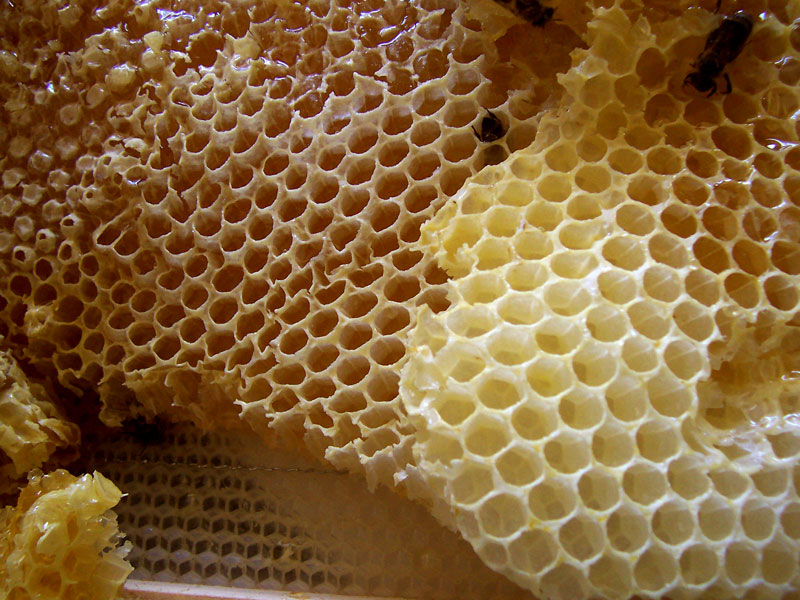
Honeycomb. Photo courtesy Wikimedia Commons.

Last week we ventured into the world of raw honey. In the realm of health foods, I know raw honey isn't too strange, but it was a first for us. First of all, it's expensive! I think it was about $12 for a square the size of an everyday, lunch bag sandwich.

But, we love to try new things, so we splurged. Plus, honey is one of nature's perfect whole foods!

Raw honey is delicious. I commented the flavor reminded me of smelling flowers; This was clover honey, so I wasn't too far off. Chewing on the honeycomb is a little strange. It was chewy like gum, but waxy at the same time. I love beeswax in cosmetics, so maybe I should save the comb instead of eating it.

What else did we learn? Raw honey (including the honeycomb) melts in a cup of hot tea. It forms a weird waxy ring around the perimeter of your cup making the tea difficult to drink.

Have you ever eaten raw honey with the honeycomb? I'd love to learn some new ways to eat this sweet treat! Please share your tips in the comments below! Otherwise, I'm just going to keep nibbling on that square bit by bit...

Until Next Time,
Choose Healthy!

Angela Tague
Whole Foods Living

###